
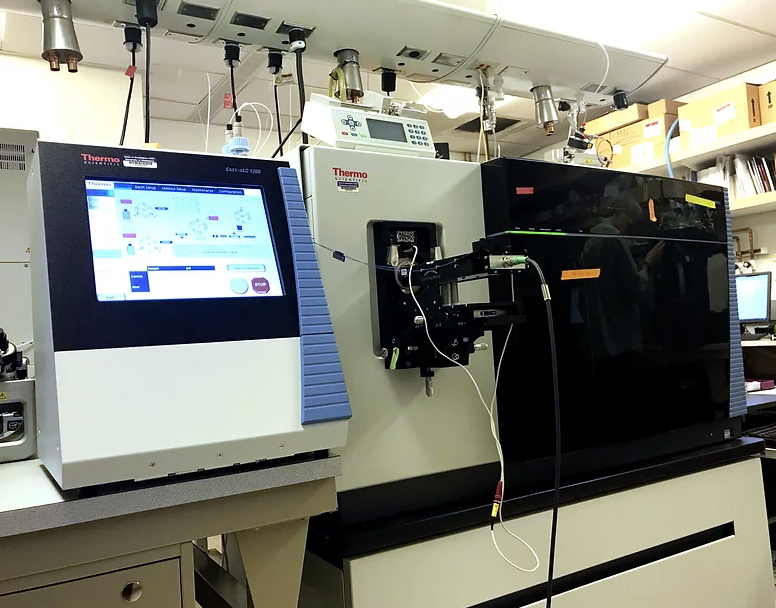
Core C provides the aging research community with access to state-of-the-art mass spectrometry-based proteomics technologies. Led by Drs. Michael MacCoss and Judit Villén, the Core delivers quantitative measurements of proteins and peptides from user-provided samples and assists researchers in linking high-dimensional proteomic data to biologically meaningful outcomes in aging. Over the past five years, Core C has served 24 laboratories from 16 institutions across the U.S., resulting in 20 publications and supporting numerous grant applications with hypothesis generation and critical preliminary data.
Core Capabilities
Quantitative Proteomics: The Core offers a comprehensive array of quantitative approaches including data-independent acquisition (DIA), data-dependent acquisition (DDA), and TMT isobaric labeling. Our targeted proteomics capabilities, enabled by Skyline software with over 200,000 installations worldwide, include highly multiplexed parallel reaction monitoring (PRM) assays capable of measuring thousands of peptides per run with no missing data.
Post-Translational Modifications: We provide automated, high-throughput phosphoproteomics (routinely quantifying >10,000 phosphosites), ubiquitylation, and acetylation profiling, with specialized expertise in PTM crosstalk studies. Our R2-P2 automated sample preparation enables robust 96-well plate processing for large-scale signaling studies.
Protein Homeostasis Assays: Core C offers specialized assays for protein turnover using metabolic labeling with precursor pool correction, protein thermal stability profiling (TPP and PISA), and protein aggregation analysis – all particularly relevant to aging and age-related diseases.
Plasma Proteomics & Biomarkers: Our novel Mag-Net extracellular vesicle enrichment method enables quantification of >5,000 proteins from plasma, providing unprecedented depth for biomarker discovery and aging clock development across multiple species including mice, dogs, non-human primates, and humans.
What Sets Us Apart
The UW Proteomics Phenotypes of Aging Core is unique among the eight Nathan Shock Centers. While Oklahoma and Rochester offer proteomics services, no other NSC provides the breadth and depth of capabilities available here. Unlike affinity-based platforms (SOMAscan, Olink) that suffer from cross-reactivity and poor target specificity, mass spectrometry provides the gold standard for accurate protein quantification. Our Core combines this analytical superiority with:
Technology Leadership: Drs. MacCoss and Villén are internationally recognized pioneers in proteomics technology development. Our group developed Skyline (the most widely used targeted proteomics software), EncyclopeDIA, Thesaurus, PanoramaWeb, and TurnoveR. We operate 11 mass spectrometers including the latest Orbitrap Astral Zoom and Stellar MS.
Novel Method Development: We have the capability to develop highly multiplexed targeted proteomics assays (>2,000 peptide targets per run), ChESS-DIA for gene regulatory proteins, protein interaction profiling, low input and spatial proteomics, and use of Mag-Net extracellular vesicle plasma proteomics for aging biomarkers.
Integrated Multi-Omics: Core C works closely with the UW NSC’s Metabolite Phenotypes (Core D), Invertebrate Longevity (Core E), and AI/Bioinformatics (Core F) Cores, enabling comprehensive multi-omics studies with hypothesis validation in model organisms. We also serve as a proteomics reference for other NSCs, including collaborations with The Jackson Laboratory.
Rigorous Quality Control: Our framework for system suitability, sample preparation QC, and batch quantification QC ensures reproducible, publication-quality data across large cohort studies.
Core Personnel: The Core is Co-Directed by Mike MacCoss and Judit Villen.
